How to use
This page walks through the recommended workflow for processing a folder of images with Quadrant Folding (QF), then describes the secondary features and the headless mode.
Workflow at a glance
Step 1 — Open an image or folder
Use File > Select an Image… (Ctrl+I) and pick any TIF/CBF/HDF5 file. QF loads the file, discovers all sibling images in that directory, and immediately processes the selected image with the default settings.
Once a folder is loaded, use the navigation arrows on the bottom strip to move through images:
< / > — previous / next image
<<< / >>> — previous / next HDF5 file (only for HDF5 input)
Process Current Folder — reprocess every image in the folder with the current settings
Process Current H5 File / Process All H5 Files — same for HDF5 frames
Already-processed images are reloaded from the cache rather than reprocessed, so navigation is fast. To force reprocessing, click Process Current Folder or delete the qf_cache folder under the output directory.
Step 2 — Choose an output directory
By default QF writes qf_results/, qf_cache/, and CSV files into the same folder as the input images. If the input directory is read-only, or you want to keep input and output separate, use File > Change Output Directory… before processing.
The output directory applies to:
qf_results/<name>_folded.tif— the folded imageqf_results/bg/<name>.bg.tif— the estimated background (when subtraction is on)summary.csv,summary2.csv,failedcases.txt— batch summariesqf_cache/— processing fingerprints used for fast reload
Step 3 — Set center and rotation on a reference image
Pick a clean, well-aligned frame as your reference. The right-hand panel Set Center and Set Rotation Angle groups contain everything needed.
Center tools
Button |
When to use |
|---|---|
Quick Center and Rotation Angle |
Auto-detect both center and rotation from the diffraction pattern. Good first attempt. |
Set Center by Chords |
Click 3 points on a strong ring; the center is fitted from the perpendicular bisectors of the chords. |
Set Center by Perpendiculars |
Draw two perpendicular lines through pairs of symmetric reflections. |
Set Center by Calibration |
Use a calibrant ring to derive both center and pixel-to-nm scale. |
Set Center Manually |
Click a single pixel to use as the center. Fast but least accurate. |
Refine Center |
Refine the current center automatically by maximizing fold symmetry. See Refine center and rotation. |
Apply Center |
Copy the current center to a chosen scope (all subsequent / all previous / all images). |
Restore Auto Center |
Discard the manual center and revert to auto-detection. |
Rotation tools
Button |
When to use |
|---|---|
Set Auto Orientation |
Open a dialog to pick the rotation-detection algorithm and whether to use Mode Orientation (use the most common angle across the folder). |
Set Angle Interactively |
Click two points to define the meridional axis. |
Set Angle Manually |
Type the angle in degrees. |
Refine Rotation |
Refine the current angle automatically with the center fixed. See Refine center and rotation. |
Apply Rotation |
Copy the current angle to a chosen scope (all subsequent / all previous / all images). |
Restore Auto Rotation |
Revert to auto-detected angle. |
For full details on all shared tools (Double Zoom, fingerprinting, calibration dialog), see Common Settings — Diffraction Center and Rotation.
Once the reference image looks right, use Apply Center and Apply Rotation (scope = whole folder) to propagate the values to every image.
Refine center and rotation
Refine Center and Refine Rotation improve an existing center and angle automatically rather than setting them from scratch, so run them after a first estimate. Both search for the geometry that makes the four quadrants most symmetric and save the result as a manual value, from which Apply Center / Apply Rotation can propagate it across the folder.
Refine Center opens a dialog that allows to select to refine the rotation together with the angle, which is useful when a calibration image is not available. This procedure takes a few minutes; however, it runs in the background and is expected to be performed once per data (more times, if the beam shifts mid-experiment). Refine Rotation refines the angle only, with the center held fixed. This is useful when a calibration image is available, so the center can be accurately determined from that.
For how the fold-symmetry objective and the three stages work, see How it works — Refinement.
Step 4 — Detect alignment across the folder
After propagating, most images will be correctly aligned, but some may have shifted center or rotation and need individual correction. Open Tools > Detect Image Alignment… (Ctrl+D) to identify outliers.
The dialog shows one row per image with columns for:
Original Center and Auto Center (with the distance between them)
Rotation and Auto Rotation (with the difference)
Center Mode / Rotation Mode — whether the values were set manually or auto-detected
Dist from Base / Rot Diff from Base — how far each image is from the chosen base image
Size and Image Difference — pixel-difference between this image and the base
Fold Std (sum) and Fold Std (norm) — fold-symmetry scores when Run symmetry test on detection is enabled (lower = more symmetric)
Click Run Detection to populate the columns. Sort by any column to surface outliers — for example, sort by Auto Center Difference to find images where the auto-detected center disagrees with the manually-applied one, or by Fold Std (norm) to find images that fold poorly. The values for Fold Std (sum) and Fold Std (norm) above the specified threshold (outliers) will be highlighted red.
The dialog is non-modal: leave it open and switch between it and the main window freely. Changes you make in the main window update the table automatically.
Step 5 — Fix individual misaligned images
For each outlier in the alignment table:
Click the row — the main window navigates to that image.
Adjust center / rotation using the Step 3 tools on the main window.
The table row updates as soon as you change the values.
Right-clicking a row offers:
Set Center and Rotation — switches focus to the main window with a hint dialog.
Set Global Base — promote this image as the reference for the
Dist from Basecolumns.Ignore — exclude this image from subsequent batch operations.
Repeat until all images are within an acceptable tolerance.
Step 6 — Inspect the result and switch display modes
Switch to the Results tab to see the folded, background-subtracted output. The display panel on the right has a Show dropdown that switches between several views without reprocessing:
Mode |
What it shows |
|---|---|
Subtracted |
Final result: average fold with background removed, mirrored to full 2D pattern. This is the default. |
Folded |
The plain average fold without background subtraction. |
Background (Non-param) |
The background image estimated by the non-parametric method. Useful for sanity-checking the subtraction. |
Background (Fit) |
The background image from the parametric (iterative 2D) fit. Appears only after the parametric fitting dialog has been opened. |
Evaluation Mask |
The composite mask used by the background optimizer (R-min/R-max annulus, equator band, peak/beam exclusions, layer lines). Appears only after Advanced Configuration for Non-parametric Background Subtraction has been opened. |
Synthetic Signal |
The synthetic Gaussian-blob grid added to the fold during optimizer scoring. Appears only after Advanced Configuration for Non-parametric Background Subtraction has been opened. |
Synthetic Mask |
The mask region of the synthetic data. Appears only after Advanced Configuration for Non-parametric Background Subtraction has been opened. |
The last three views are diagnostic aids for tuning the optimizer and stay hidden until you open Advanced Configuration for Non-parametric Background Subtraction; Background (Fit) stays hidden until you open the parametric fitting dialog. The dropdown lists only the views that apply to the work you have started.
Other Results-tab controls:
Rotate 90 degree — rotate the displayed result by 90° (also rotates the saved tif).
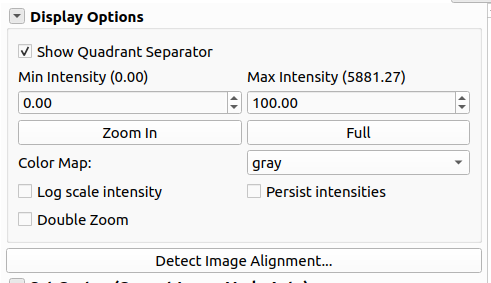
Show Quadrant Separator — draw the horizontal/vertical lines separating the four mirrored quadrants.
Persist intensity — keep the min/max intensity range across images.
Step 7 — Configure background subtraction (optional)
Background subtraction is not required for quadrant folding itself. If you only need the folded image (higher signal-to-noise, no diffuse background removed), leave the method as None and skip to Step 8. Use this step when you want to remove the diffuse muscle background before saving or downstream analysis.
The Background Subtraction group on the right panel is the central control. QF offers three approaches, from the most basic and hands-on to the most automated. For the full description of every method, parameter, and metric, see Background Subtraction.
Manual non-parametric subtraction
The most basic approach: you pick one method and set its parameters yourself. Expand Non-parametric Background Subtraction and in Subtraction Method choose one of the methods (2D Convexhull, Circularly-symmetric, White-top-hats, Roving Window, Smoothed-Gaussian, Smoothed-BoxCar, Average or None), and tune its parameters by hand. Then click Apply Selected Subtraction Settings. Use this when you already know which method suits your data. See Background Subtraction — Subtraction methods and parameters and Manual Setting.
Transition mode
When a single method does not work well across all radii, use two non-parametric methods and blend them: one for the inner region, one for the outer. Switch the right-panel Options dropdown to Manual Setting | Transition. Two method choices and parameter sets appear; configure each independently and set:
Transition radius — where the two backgrounds are blended (typical guideline: just outside the M3 meridional peak).
Transition delta — width of the linear blend region.
See How it works — Step 9 for the algorithmic detail.
Automated (optimized) subtraction
Instead of choosing parameters by hand, let QF search for them. Switch the right-panel Options dropdown to Automated Processing. The quickest form is the blue Apply Default Optimization button: QF runs the automated optimizer on the current image using the default method set and writes the chosen method and parameters back to the Current Configuration display. This is the recommended first step on a new dataset. For finer control, open Advanced Configuration, and choose which methods to try, the step schedule, max iterations, and an early-stop loss threshold. See Background Subtraction — Automated Processing.
The Advanced Configuration dialog
The automated approach uses the Advanced Configuration (Background Subtraction Settings) dialog for the optimizer, evaluation masks and metrics, saved configurations, and batch launch. Its three-step layout is documented in full on the Optimization Settings page.
Parametric (iterative 2D) fitting
The parametric method models the diffuse background as an explicit 2D function — an equatorial-streak component plus a general background component — and subtracts it, rather than estimating it numerically. Expand the Parametric Background Fitting panel and open the Iterative 2D Background Fitting Dialog. Use it when the the background should be removed on the whole pattern or when a smooth analytic background is preferable. It can be combined with a non-parametric method: after applying a parametric fit, enable Subtract fitted before non-parametric so a non-parametric method runs on top of the fitted residual. See Background Fitting for the full model and settings reference.
Step 8 — Process the whole folder and collect output files
When the settings look right on representative images, click Process Current Folder (either the navigation button or the one inside the Background Subtraction dialog). QF writes the following under the output directory:
qf_results/
File |
Description |
|---|---|
|
The folded, background-subtracted result image (32-bit float TIFF). When Save Compressed Image is checked, written as |
|
One row per processed image. Key columns: |
|
Same data, transposed for easier spreadsheet analysis. |
|
Images that could not be processed automatically (no peaks, fitting failed, high error, or manually rejected). |
qf_results/bg/
Written when a background-subtraction method other than None is active.
File |
Description |
|---|---|
|
The estimated background image (32-bit float TIFF). |
|
|
|
Per-image raw and normalized evaluation metrics with their weights and running means. Written only when Save result metrics to csv is enabled. |
For the meaning of loss, bgSum, and symmetry, see How it works — Step 11.
Other features
Right-click — Ignore a quadrant
Right-click on any quadrant in the Original Image tab and choose Ignore This Quadrant. The selected quadrant is excluded from the averaging step (useful when one quadrant has a detector defect or shadow). Use Unignore This Quadrant to re-include it.
Save and load settings
File > Save Current Settings (
Ctrl+S) — write current parameters toqfsettings.json. Per-image state (center, rotation, ROI per image) is not included.File > Load Settings… (
Ctrl+Shift+S) — load a settings file and reprocess.
Fold Image checkbox
Unchecking Fold Image processes the original (unfolded) image as if it were already folded. Useful when the input is already a quadrant-folded result from a previous run.
Headless Mode
For batch processing without a GUI, run from the terminal:
musclex qf -h -i <file.tif> [-s qfsettings.json] [-d]
musclex qf -h -f <folder>   [-s qfsettings.json] [-d]
Arguments:
-i <file>— process a single file.-f <folder>— process every image in the folder.-s <settings.json>— load a settings file (generated by File > Save Current Settings in the GUI). Without this, defaults are used.-d— delete the existing cache before processing.
.. note:: On Windows, replace ``musclex`` with ``musclex-main.exe`` (typically under ``C:\Program Files\BioCAT\MuscleX\musclex``).
Multiprocessing
The headless runner processes one image per CPU core. Output for each worker is prefixed with the process index so interleaved log lines can be untangled.
Reference for setting file qfsettings.json
The setting file may be used during headless processing or loaded in the GUI using File > Load Settings…. Only the geometry and output keys apply to every run. Everything related to background subtraction is optional — those keys take effect only when a background method is active (bgsub set, optimize on, or the parametric fit enabled). Keys unknown to the loader are ignored, so a "// ..." entry is a valid, self-documenting comment. Names ending in _out are the outer-radius counterparts used in Transition mode. For the full set of accepted keys, see musclex/modules/QuadrantFolder.py.
Base case — fold only, no background subtraction
The minimum needed to fold a folder with a fixed geometry. No background is removed.
{
    "// FILE": "Base case: quadrant-fold only, no background subtraction.",

    "// ==== GEOMETRY (always applied) ====": "",
    "fix_center": true,
    "center_x": 1024,
    "center_y": 1024,
    "rotation": 0,

    "// ==== BACKGROUND (off) ====": "Leave bgsub None and the mode switches off. These values are the default values.",
    "bgsub": "None",
    "optimize": false,
    "fit_bg_each_image": false,
    "subtract_bg_fit": false,

    "// ==== OUTPUT (always applied) ====": "",
    "compressed": true,
    "freq": "medium"
}
Extended — with background subtraction
Adds the optional background block. Each // ==== zone below is used only when its mode switch is on; delete the zones you do not need.
{
    "// FILE": "Extended: quadrant-fold with background subtraction. Everything under BACKGROUND is used only when its mode switch is on.",

    "// ==== GEOMETRY (always applied) ====": "",
    "fix_center": true,
    "center_x": 1024,
    "center_y": 1024,
    "rotation": 0,

    "// ==== BACKGROUND: mode switches (pick one or combine; all optional) ====": "",
    "// bgsub": "Non-parametric method to apply. \"None\" = none. Overwritten by the optimizer when optimize=true.",
    "bgsub": "Circularly-symmetric",
    "// optimize": "true = search 'methods' for the best non-parametric background and apply it.",
    "optimize": false,
    "// fit_bg_each_image + subtract_bg_fit": "Both true = run and subtract the iterative 2D parametric fit (before the non-parametric optimizer, if any).",
    "fit_bg_each_image": false,
    "subtract_bg_fit": false,
    "// bg_options": "0 = single region, 1 = two-zone Transition mode.",
    "bg_options": 0,

    "// ==== BACKGROUND: image prep (only when subtracting) ====": "",
    "downsample": 2,
    "smooth_image": true,
    "fixed_rmin": 100,
    "fixed_rmax": 900,

    "// ==== BACKGROUND: non-parametric method parameters ====": "Only the keys for the active bgsub / searched methods matter.",
    "degree": 1,
    "radial_bin": 1,
    "cirmin": 10, "cirmax": 100,
    "smooth": 1,
    "tension": 1,
    "win_size_x": 11, "win_size_y": 11,
    "fwhm": 20,
    "boxcar_x": 20, "boxcar_y": 15,
    "cycles": 1,

    "// ==== BACKGROUND: Transition mode outer region (only when bg_options=1) ====": "Keys ending in _out are the outer-radius counterparts.",
    "bgsub_out": "None",
    "deg2": 1,
    "smooth2": 1,
    "tension2": 1,
    "win_size_x_out": 11, "win_size_y_out": 11,
    "fwhm_out": 20,
    "boxcar_x_out": 20, "boxcar_y_out": 15,
    "cycles_out": 1,
    "transition_radius": 730,
    "transition_delta": 60,

    "// ==== BACKGROUND: parametric (iterative 2D) fit (only when fit_bg_each_image=true) ====": "All bgfit_* keys are optional; shown at defaults.",
    "bgfit_comp2": "lorentzian",
    "bgfit_iters": 5,
    "bgfit_eq_max_nfev": 1000,
    "bgfit_gen_max_nfev": 600,
    "bgfit_fit_size": 800,
    "bgfit_downsample": 2,
    "bgfit_use_step0": true,
    "bgfit_general_reduction": 0.05,
    "bgfit_equator_reduction": 0.05,
    "bgfit_auto_reduce": true,

    "// ==== BACKGROUND: optimizer tuning (only when optimize=true) ====": "",
    "methods": ["Smoothed-Gaussian", "White-top-hats"],
    "max_iterations": 30,
    "early_stop": 0.005,

    "// ==== BACKGROUND: equator / layer-line mask (protects reflections) ====": "",
    "equator_mask_height": 60,
    "equator_center_beam_width": 80,
    "m1": 82,
    "layer_line_width": 8,

    "// ==== OUTPUT (always applied) ====": "",
    "save_metrics_to_csv": false,
    "compressed": true,
}
bg_options:0= single method,1= Transition (usesbgsub_outoutsidetransition_radius).optimize: when true, ignoresbgsuband runs the automated optimizer overmethods.mask_thresis no longer user-configurable; invalid pixels are detected at the value −1 set by the empty-cell-and-mask preprocessing stage.